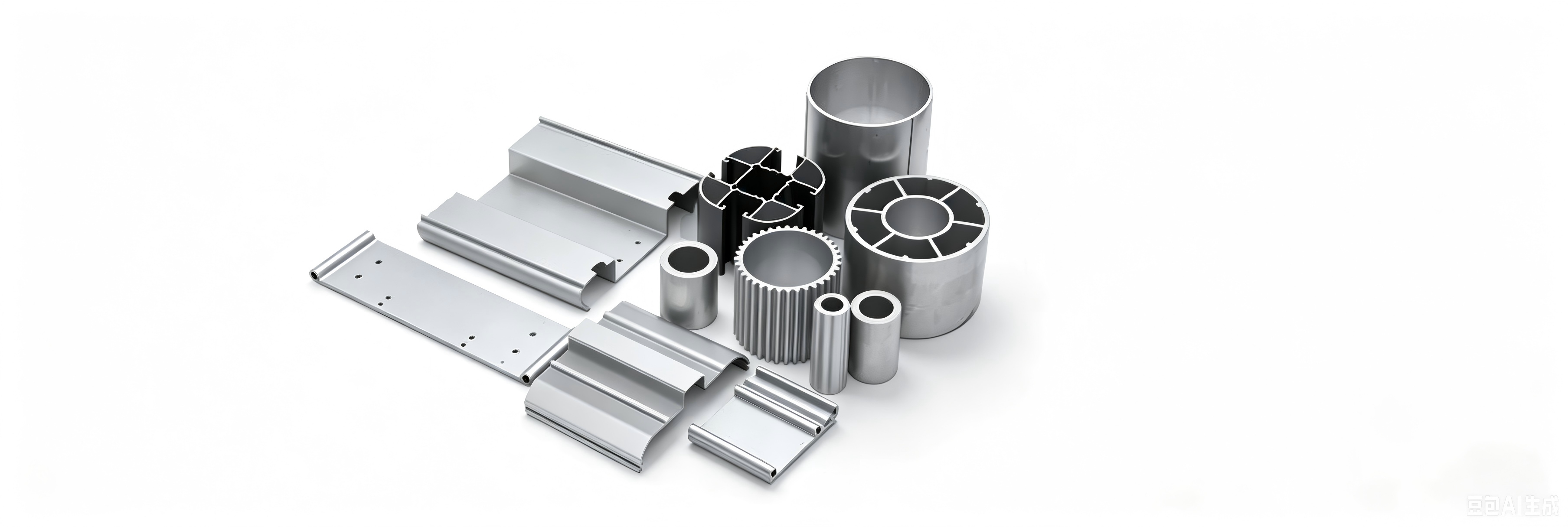
Most low-cost aluminum canopy poles circulating in the North American market adopt die-cast or die-cut forming processes, while high-end engineering and branded outdoor products uniformly adopt hot extrusion processing. Many purchasers cannot accurately distinguish the essential performance differences between the two processes, easily choosing low-cost die-cut products for long-term outdoor projects, resulting in structural deformation, premature aging and frequent replacement. As a professional OEM manufacturer focusing on precision aluminum extrusion, hard anodizing and CNC finishing, we elaborate on the full-dimensional advantages of customized extrusion processing with verified industrial data, providing reliable process selection basis for North American outdoor brand purchasers and engineering contractors.
The fundamental difference between extrusion and die-cut forming lies in aluminum metal grain structure molding. Die-cut poles are formed by cold stamping and cutting aluminum plates, with disordered, broken and discontinuous internal metal grains, resulting in uneven local stress and poor overall structural toughness. In contrast, our hot extrusion process adopts 420-480°C high-temperature billet heating and 1200-ton hydraulic integral extrusion, forcing aluminum alloy to flow through precision molds, forming continuous, dense and directional grain fiber structure. Professional metallographic detection data shows that the grain density of extruded poles is 37% higher than die-cut poles, and the internal structural compactness reaches 99.8%, completely eliminating loose pores and grain breakage defects of die-cut products.
Mechanical performance test data fully verifies the structural advantages of extruded poles. Under the same 6061-T6 alloy specification and wall thickness, the average tensile strength of die-cut aluminum canopy poles is only 225MPa, and the yield strength is 178MPa; while our custom extruded poles reach 262MPa tensile strength and 208MPa yield strength, with overall mechanical performance improved by 16.4% and 16.8% respectively. In 2500Pa extreme wind pressure simulation tests, die-cut poles produce 2.1mm irreversible bending deformation, while custom extruded poles have zero permanent deformation, showing far stronger structural load-bearing stability.
Dimensional consistency and batch stability are core advantages of extrusion OEM processing. Die-cut products are affected by plate raw material tolerance and cold stamping deformation, with batch size deviation up to ±0.3mm, resulting in poor assembly matching and frame structural imbalance. Our precision extrusion process adopts fixed mold parameter locking and 1-3% directional stretching straightening technology after forming, controlling overall dimensional tolerance within ±0.05mm, and batch size deviation less than 0.03mm. This ultra-high consistency ensures universal interchangeability of customized canopy poles and accessories, greatly reducing on-site assembly difficulty and project after-sales maintenance costs.
Outdoor fatigue resistance and service life gap are extremely obvious. We completed 100,000 cyclic wind vibration fatigue tests for both process products. Die-cut poles produce obvious micro-cracks at cutting edges and stress concentration parts after 40,000 cycles, with overall rigidity attenuated by 18%, and fail completely after 80,000 cycles. Custom extruded poles maintain stable structural performance after 100,000 full cycles, with rigidity attenuation less than 3%, and no crack or loosening failure. Converted to actual outdoor use, the fatigue life of extruded poles is 2.8 times that of die-cut poles, perfectly adapting to long-term wind and rain erosion in North American open outdoor environments.
Surface processing adaptability determines outdoor anti-corrosion and aesthetic performance. The broken grain structure of die-cut poles leads to uneven surface density, resulting in inconsistent anodizing film thickness, easy color difference and poor corrosion resistance. The continuous and dense grain structure of custom extruded poles supports uniform oxide film growth, with hard anodizing film thickness error controlled within ±1μm, and surface color difference ΔE<1.0. After 1500 hours of neutral salt spray testing, extruded poles have zero corrosion spots, while die-cut poles have obvious pitting corrosion and oxide film peeling.
Many buyers worry that custom extrusion processing has high comprehensive costs. In fact, although the unit processing cost of extruded poles is 12% higher than die-cut poles, the ultra-long service life and zero after-sales failure rate reduce the 10-year comprehensive use cost by 29%. For commercial canopies, municipal outdoor facilities and branded outdoor products with long-term operation requirements, custom extrusion OEM processing has far higher cost performance.
Our one-stop extrusion OEM service supports full-customized canopy pole specification optimization, including wall thickness adjustment, internal reinforcing rib design and special-shaped profile extrusion. Combined with subsequent customized hard anodizing and CNC precision finishing, we provide exclusive process solutions for different outdoor scenarios, helping North American B2B customers create high-stability, long-life aluminum canopy products.
In summary, custom hot extrusion processing is the fundamental guarantee for high-performance aluminum canopy poles. Die-cut products are only suitable for temporary low-demand scenarios, while precision extruded OEM poles are the standard choice for formal North American outdoor engineering and branded products. Professional process customization is the core to improve product competitiveness and project safety.

Suzhou YuSanhe Material Technology Co., Ltd.
Domestic Sales Section
Address: No.6, Mei Hui Road, Donglai Village, Yangshe Town, Zhangjiagang City, Suzhou, Jiangsu Province, China
Contact Person: Zhen Liu
Mobile/Phone/Wechat: +86 166-0512-2626
Email: samlinge0512@gmail.com samlinge@163.com